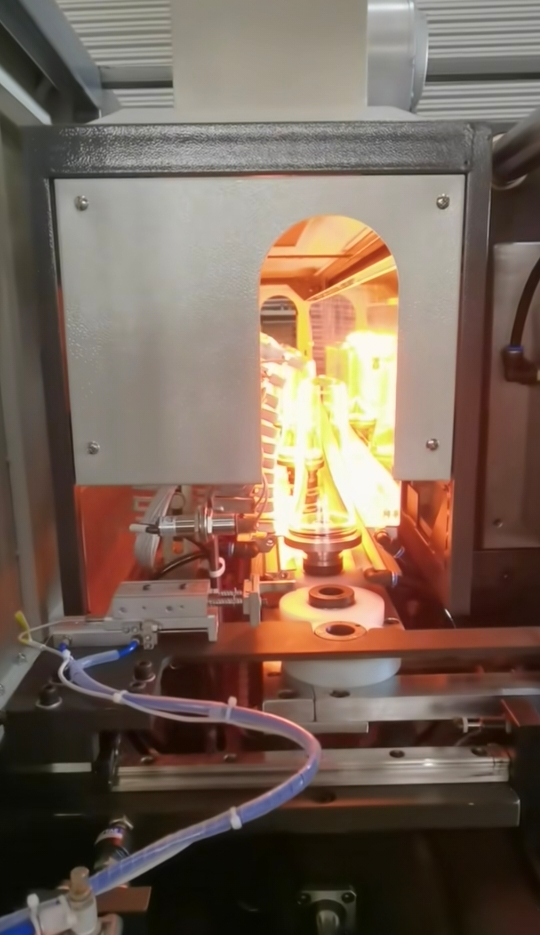
On the line, oil bottle preforms are heavier and thicker than standard PET, so the heating tunnel has to dump heat in fast—and do it evenly. Let the profile drift and you’ll see weak necks, crystallized shoulders, or parisons that blow out. That burns resin, drags down the blow molder, and keeps you re-tuning all shift.
What matters under the hood
We built the oil bottle thick-preform heater around short-wave infrared halogen emitters in quartz tubes. They respond quickly and pack serious power density. You can spec 1.5–3.0 kW per zone, 220–480 V to match your plant, and fit the physical envelope of your heating tunnel, right down to standard R7s connectors. The reflector geometry is shaped to concentrate the beam pattern on the preform wall, and closed-loop control keeps the thermal profile tight across the neck and body. With thick sections, the module drives heat in faster without scorching the surface—so cycle time comes down and stretch ratios stay stable.
Why it holds up in real production
This module is built to run on Sidel, Krones, SIPA, Husky, SACMI, and Nissei ASB blow molders, with 1:1 parameter matching to the OEM heating zones. In oil bottle runs, that translates to hitting the required parison temperature with fewer hot spots and fewer cold bands. Wall thickness stays consistent, and bottle integrity follows. Energy use drops because the emitter only fires when needed and cools quickly between cycles. Maintenance is simpler, too: you can swap individual emitters without pulling the whole bank, which cuts unplanned downtime.
The practical details that save you headaches
Installation is straightforward, but alignment is everything. Even a small offset in emitter focus shifts the heat band and can push the preform out of spec. Match your preform conveyor spacing to the zone pitch, and make sure the lamp ends are fully seated in the R7s sockets to avoid arcing. Keep the quartz tubes clean—film dust and condensation will mess with performance. In high-humidity plants, sealed end caps help. The module runs hot, so leave clearance for airflow and service access.