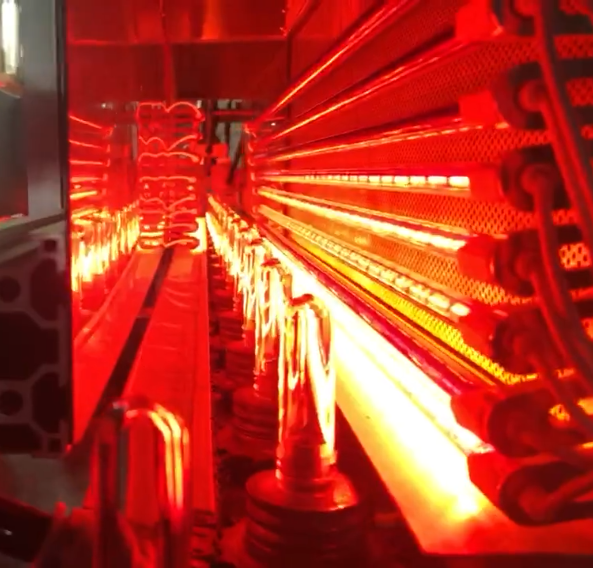
On the blow molding floor, the heating tunnel is where you either make your uptime or lose it. Preforms fly through at line speed, and the heating window is razor-thin. Too cool, and you get weak bottles and blown cavities. Too hot, and you’re staring at haze, crystallization, and finishes that are off-spec. When your old infrared emitters start fading, cycle times drift, and scrap climbs, you don’t need a lecture. You need a heater that matches the machine, the process, and the numbers. We build fast medium wave quartz heaters specifically for PET stretch blow molding, engineered to run on blow molders from Sidel, Krones, SIPA, Husky, SACMI, and Nissei ASB. These aren’t generic lamps. They’re calibrated, dimensioned, and terminated to drop straight into the same heating tunnels, with output profiles that line up with the preform heating strategy your machine expects.
What matters, technically
Fast medium wave sits right between short wave and long wave. The output peaks in the medium infrared band, which penetrates PET more evenly and heats the wall thickness without overshooting the surface. The payoff is predictable temperature distribution across the preform—neck to base—with less thermal shock. We designed these heaters for the reality of continuous blow molding:
- Fast thermal response: full output in seconds, so the heating zone keeps up with line speed changes without lag.
- Focused output: the spectrum and reflector geometry target the preform, not the surrounding frame.
- Stable output over life: we control filament geometry and quartz purity to keep performance consistent, so you’re not chasing setpoints as the lamp ages.
- Physical fit: standard lengths and diameters, with R7s connectors and ceramic terminals, so the lamp seats squarely and makes solid contact. In practice, that means repeatable heating curves, fewer hot spots, and less variance in bottle wall thickness. You run the same temperature profile longer, and spend less time tweaking setpoints to compensate for lamp drift.
Why this works on blow molders
In stretch blow molding, the heating tunnel is a closed loop of constraints. Preforms arrive at a set rate, and the heater has to deliver the energy to hit the correct stretch temperature within that window. If the lamp can’t respond fast, you either slow the line or live with inconsistent bottles. If output falls off early, scrap goes up and changeovers multiply. Our fast medium wave quartz heaters are matched to blow molding machines because they were built for the duty cycle of preform heating:
- They hit target output quickly, so you can hold line speed when the machine ramps up or switches formats.
- The medium wave profile reduces surface-to-core temperature swing, which helps with even stretching and consistent bottle weight.
- The lamps are engineered to the same envelope and mounting as the originals, so you can replace one-for-one without modifying the holder, bracket, or wiring. That translates to fewer temperature-related rejects, fewer unscheduled stops to swap lamps, and more consistent output from shift to shift. It also cuts down on wasted energy heating the frame and belts, because the energy is concentrated where it needs to be—on the preform.
The practical details
Installation is straightforward on most blow molders, but a few details make or break it.
- Match the holder and termination. Confirm the R7s base, terminal orientation, and overall length against your existing lamp. A mismatch can cause poor contact, arcing, and uneven heating.
- Verify voltage at the socket. Line voltage can drift, and even a small variance changes output and life. Use a true RMS meter and log the reading at the terminal.
- Keep the reflector clean and aligned. A dirty reflector scatters output and robs you of the designed energy density on the preform.
- Plan for warm-up. Even fast emitters need about a minute to stabilize. Set up your startup so the heating zone is at setpoint before preforms enter. One trade-off is real: fast medium wave quartz heaters deliver high intensity and fast response, but they’re sensitive to ambient airflow and mechanical shock. Treat them like precision components, not rough-and-tumble consumables. Mount them securely, avoid impacts, and keep tunnel airflow consistent. With proper handling, output stays stable over long runs, and replacements become predictable—not emergency-driven. If you’re running PET on Sidel, Krones, SIPA, Husky, SACMI, or Nissei ASB, and your heating tunnel is fighting inconsistent bottles, rising scrap, or unpredictable lamp life, the fix starts with a heater spec’d for the job. We supply fast medium wave quartz heaters that fit, perform, and last—because on the blow molding line, the only acceptable heat is the right heat, delivered on time, every time.